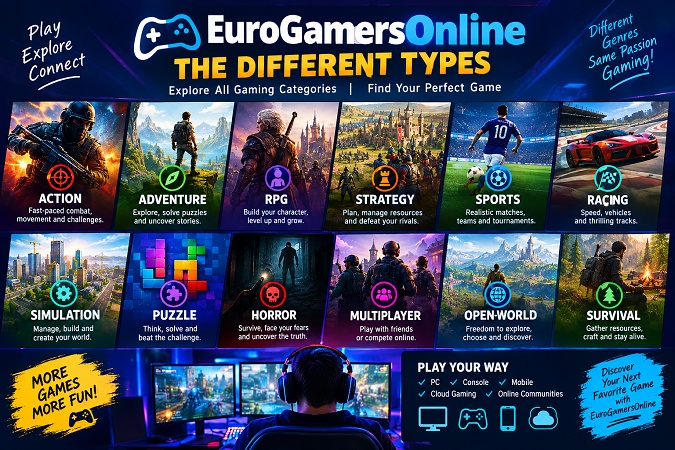

The gaming world has expanded far beyond traditional console and computer games. Today, players can choose from thousands of gaming experiences across mobile devices, PCs, consoles, browsers, and online platforms. As gaming communities continue to grow, understanding the different categories can help players discover experiences that match their interests, preferred devices, and playing styles. This is where the topic “eurogamersonline the different types” becomes useful for anyone exploring the broad range of modern gaming.
Eurogamersonline can be understood as a gaming-focused concept associated with online gaming content, game categories, entertainment, and digital communities. Within the wider gaming ecosystem, different types of games offer different objectives, mechanics, levels of competition, and social experiences. Some games focus on storytelling, while others emphasise competition, strategy, teamwork, exploration, creativity, or fast-paced action.
This guide explores the different types of gaming experiences that players may encounter when researching Eurogameronline and the wider online gaming environment. It also explains the characteristics of each category, common platforms, advantages, and factors players should consider before choosing a game.
Also Read: ETSiOSApp Version from eTrueSports
What Does Eurogamersonline The Different Types Mean?
The phrase “eurogamersonline the different types” refers broadly to exploring different categories and styles of games available through online gaming culture. Rather than representing just one specific game genre, the phrase can be used as a starting point for understanding the variety of gaming experiences available to modern players.
Online gaming includes everything from competitive multiplayer matches to casual puzzle games. There are also role-playing games, strategy games, sports simulations, racing titles, adventure experiences, survival games, and massively multiplayer online games.
Each category has its own gameplay structure. For example, an action game may require quick reactions, while a strategy game generally rewards planning and decision-making. A role-playing game may focus more heavily on character development and storytelling.
Understanding these differences makes it easier for players to identify the types of games they are most likely to enjoy.
Why Are There So Many Different Types of Games?
The gaming industry serves a huge international audience with different interests and expectations. Developers therefore create games with different mechanics, themes, difficulty levels, and social features.
Technology has also contributed to this diversity. Modern smartphones allow developers to create sophisticated mobile experiences, while powerful PCs and consoles can support large worlds, advanced graphics, and complex multiplayer systems.
Online connectivity has created another major change. Players can now compete or cooperate with people in different countries. This has encouraged the growth of multiplayer games, esports, online communities, and live-service gaming.
As a result, the modern gaming landscape contains numerous categories rather than one standard gaming format.
1. Action Games
Action games are among the most recognisable gaming categories. They generally emphasise quick reactions, movement, combat, timing, and direct interaction with the game environment.
Players may need to defeat opponents, complete missions, avoid obstacles, or overcome challenging levels. Some action games are designed around single-player campaigns, while others include multiplayer modes.
The appeal of action games often comes from their fast pace. Players who enjoy immediate challenges and responsive controls may find this category particularly engaging.
Common elements include:
- Fast-paced gameplay
- Combat mechanics
- Reflex-based challenges
- Missions and objectives
- Character abilities
- Competitive multiplayer modes
Action games can also overlap with other categories, including adventure, role-playing, and shooting games.
2. Adventure Games
Adventure games usually focus on exploration, discovery, storytelling, puzzles, and interaction with characters or environments.
Instead of emphasising constant combat, adventure titles may encourage players to investigate locations, solve mysteries, collect information, and progress through a narrative.
Modern adventure games can include large open worlds, branching stories, environmental puzzles, and character-driven experiences.
This category is particularly suitable for players who enjoy discovering new environments and following stories at their own pace.
3. Role-Playing Games
Role-playing games, commonly called RPGs, allow players to control characters who develop throughout the game.
Character progression is one of the defining features of RPGs. Players may gain experience, unlock abilities, improve equipment, complete quests, and make decisions that influence their journey.
Some RPGs are heavily focused on narrative, while others emphasise combat, exploration, or multiplayer interaction.
Typical RPG features include:
- Character customisation
- Experience and levelling
- Quests
- Equipment systems
- Skills and abilities
- Story progression
- Exploration
Online RPGs can also create persistent worlds where players interact with large communities.
4. Strategy Games
Strategy games focus on planning, resource management, decision-making, and tactical thinking.
Players may control armies, build civilisations, manage resources, develop technologies, or compete against other players. Success often depends on making effective decisions rather than simply reacting quickly.
Strategy games are commonly divided into real-time strategy and turn-based strategy.
In real-time strategy games, players make decisions while the game continues. In turn-based games, players usually have dedicated turns to plan their actions.
Strategy gaming can appeal to players who enjoy analysing situations and developing long-term plans.
5. Sports Games
Sports games recreate real-world or fictional sporting experiences. Popular themes include football, basketball, tennis, racing, cricket, golf, and other sports.
These games may include single-player career modes, local multiplayer, online competitions, and team-management systems.
Sports games can be especially appealing to fans who want an interactive version of their favorite sport.
Online sports games also provide opportunities to compete against other players and participate in ranked competitions.
6. Racing Games
Racing games focus on speed, vehicles, tracks, competition, and driving skills.
Players may race cars, motorcycles, futuristic vehicles, boats, or other machines. Some titles aim for realistic driving physics, while arcade-style racing games prioritise accessibility and entertainment.
Common features include:
- Vehicle customisation
- Different tracks
- Multiplayer racing
- Time trials
- Career modes
- Competitive rankings
Online racing can create highly competitive environments where small differences in timing and control can determine the result.
7. Simulation Games
Simulation games attempt to reproduce real-world activities or systems in an interactive format.
Players may manage cities, operate vehicles, run businesses, build homes, farm land, or perform other simulated activities.
The defining feature is usually the attempt to represent a process or system rather than simply completing traditional action-orientated levels.
Simulation games can range from highly realistic experiences to simplified and casual titles.
8. Puzzle Games
Puzzle games focus primarily on logic, problem-solving, patterns, memory, timing, or spatial reasoning.
They can be extremely simple or surprisingly complex. Mobile platforms have helped puzzle games become particularly accessible because many can be played during short sessions.
Examples of puzzle mechanics include:
- Matching objects
- Solving logical problems
- Finding patterns
- Rearranging objects
- Navigating mazes
- Completing sequences
Puzzle games can be suitable for players who prefer mental challenges over combat or competitive action.
9. Multiplayer Online Games
Multiplayer online games allow multiple players to participate in the same digital environment or match.
These games can involve cooperation, competition, communication, and team-based objectives.
Players may form teams with friends or meet other players through matchmaking systems. Depending on the game, multiplayer experiences can range from short matches to persistent online worlds.
Online multiplayer has become one of the most important areas of modern gaming because it transforms gaming from an individual activity into a social experience.
10. Massively Multiplayer Online Games
Massively multiplayer online games, often known as MMOs, support large numbers of players within persistent online environments.
Players may create characters, complete quests, join groups, trade items, explore worlds, and participate in large-scale activities.
MMOs often include extensive progression systems and communities that remain active for years.
The social component is particularly important. Players can communicate, cooperate, form teams, and participate in events together.
11. Battle Royale Games
Battle royale games place multiple players or teams into a competitive environment where participants attempt to survive until the end.
Many battle royale games include a shrinking play area, resource collection, equipment systems, and elimination mechanics.
The format combines exploration, survival, combat, and strategy. Players must decide when to fight, when to avoid confrontation, and how to use available resources.
Because matches can produce unpredictable outcomes, battle royale games have become an important part of online gaming culture.
12. Casual Games
Casual games are generally designed to be easy to understand and accessible to a broad audience.
They often feature short sessions, simple controls, and straightforward objectives.
Casual gaming is especially common on smartphones and browsers. Players can enjoy these games without necessarily committing to long sessions.
Examples include simple puzzles, card games, arcade experiences, word games, and casual simulation titles.
13. Indie Games
Independent, or indie, games are generally created by smaller development teams or independent developers rather than large publishers.
Indie developers often experiment with unusual mechanics, artistic styles, storytelling techniques, or game structures.
This makes indie gaming an important part of gaming diversity. Some independent titles become widely recognised because they offer experiences that differ from mainstream releases.
Players exploring the different types associated with online gaming should not overlook indie games because they can provide highly creative experiences.
14. Esports and Competitive Gaming
‘Esports’ refers to organised competitive gaming, where players or teams compete in structured events.
Competitive gaming can involve different genres, including strategy, sports, shooters, fighting games, and multiplayer online battle arenas.
Esports ecosystems may include professional players, teams, tournaments, commentators, coaches, and large online communities.
For players interested in competition, esports can add another dimension to gaming by emphasising skill development, teamwork, strategy, and tournament play.
Comparison Table: Different Types of Online Games
| Game Type | Main Focus | Typical Experience | Suitable For |
|---|---|---|---|
| Action | Combat and reflexes | Fast-paced | Action fans |
| Adventure | Exploration and story | Narrative-focused | Explorers |
| RPG | Character progression | Long-term development | Story and progression fans |
| Strategy | Planning | Tactical | Strategic thinkers |
| Sports | Athletic simulation | Competitive | Sports fans |
| Racing | Speed and driving | Competitive | Racing enthusiasts |
| Simulation | Real-world systems | Realistic or creative | Management fans |
| Puzzle | Problem-solving | Mental challenge | Puzzle players |
| Multiplayer | Competition/cooperation | Social | Online communities |
| MMO | Persistent worlds | Large-scale | Long-term players |
| Battle Royale | Survival | Competitive | Competitive players |
| Casual | Simple entertainment | Short sessions | Casual players |
| Indie | Creativity | Experimental | Curious players |
| Esports | Organised competition | Highly competitive | Competitive gamers |
Choosing the Right Type of Game: Eurogamersonline The Different Types
Choosing a game category depends heavily on personal preference. There is no single genre that suits every player.
Players who enjoy fast reactions may prefer action or racing games. Someone interested in stories might prefer adventure or RPGs. Those who enjoy planning could explore strategy games, while sports fans may prefer sports simulations.
Device compatibility is another important consideration. A game designed for PC or console may require more powerful hardware than a typical mobile game.
Players should also consider whether they prefer solo or multiplayer experiences. Single-player games provide more control over the pace, while multiplayer titles can offer social interaction and competition.
The Role of Online Communities: Eurogamersonline The Different Types
Online communities have become an important part of gaming culture. Players can discuss games, share strategies, exchange tips, watch gameplay, and participate in community events.
Gaming communities can exist through forums, social platforms, streaming services, Discord servers, and dedicated gaming websites.
For a concept such as eurogamersonline the different types, community discussion can help players understand how different genres work and what makes each category distinctive.
However, players should use good online safety practices. Avoid sharing sensitive personal information, use strong account security, and be cautious when communicating with unknown users.
Mobile, PC, Console, and Browser Gaming: Eurogamersonline The Different Types
Modern gaming is available across many devices.
Mobile gaming provides convenient access through smartphones and tablets. It is often designed around touch controls and flexible session lengths.
PC gaming provides extensive customisation options and supports many genres, including strategy, simulation, RPG, competitive multiplayer, and indie games.
Console gaming focuses on dedicated hardware and often provides optimised controls and high-quality audiovisual experiences.
Browser gaming can provide quick access to games without requiring a large installation, although available features depend on the individual title.
The best platform depends on the player’s preferences, hardware, budget, and desired gaming experience.
Future Trends in Different Types of Gaming: Eurogamersonline The Different Types
The gaming industry continues to evolve. Cloud gaming, artificial intelligence, virtual reality, augmented reality, improved online infrastructure, and cross-platform play are influencing how games are developed and experienced.
Cross-platform functionality is particularly significant because it allows players on different supported devices to interact within the same gaming environment.
Virtual and augmented reality may also create more immersive experiences by changing how players interact with digital environments.
At the same time, developers continue experimenting with new combinations of genres. A single game may combine RPG progression, action combat, strategy mechanics, social systems, and exploration.
This blending of categories means that the traditional boundaries between genres are becoming less distinct.
Tips for Exploring Different Game Types: Eurogamersonline The Different Types
If you are new to gaming or want to discover something different, consider the following approach:
- Start with a genre that matches your existing interests.
- Try both single-player and multiplayer experiences.
- Explore different platforms if you have access to them.
- Read reliable reviews before spending money.
- Watch gameplay to understand how a game works.
- Try free demos or free-to-play games where appropriate.
- Experiment with genres outside your usual preferences.
- Protect your gaming accounts with strong passwords and security features.
- Set reasonable gaming-time limits.
- Focus on games that provide an enjoyable and comfortable experience.
(FAQs): About Eurogamersonline the different types
What does “eurogamersonline the different types” mean?
The phrase refers broadly to exploring different types and categories of games within online gaming culture and platforms. It can cover genres such as action, adventure, RPG, strategy, sports, racing, simulation, puzzle, and multiplayer gaming.
What are the most common types of online games?
Common categories include action, adventure, RPG, strategy, sports, racing, simulation, puzzle, multiplayer, MMO, battle royale, and casual games.
Are all online games multiplayer?
No. Some games require an internet connection but are primarily designed for individual play. Others are fully multiplayer and depend on interaction between multiple players.
Which gaming type is best for beginners?
There is no universal choice. Casual, puzzle, adventure, and some sports games can be accessible starting points, but the right category depends on the player’s interests and preferred level of challenge.
What is the difference between RPG and strategy games?
RPGs generally emphasise character development, progression, quests, and storytelling. Strategy games primarily emphasise planning, resource management, tactics, and decision-making.
What are indie games?
Indie games are generally produced by independent developers or smaller teams. They often experiment with creative mechanics, unusual stories, and distinctive artistic styles.
What is an MMO?
An MMO, or massively multiplayer online game, is a game designed to support large numbers of players within an online environment. Many MMOs feature persistent worlds, character progression, quests, and social systems.
Can one game belong to multiple categories?
Yes. Many modern games combine several genres. For example, a game can contain RPG progression, action combat, exploration, and multiplayer features at the same time.
Why are gaming genres important?
Genres help players understand what kind of gameplay to expect. They also make it easier to discover games that match personal interests.
How can I find new types of games?
Players can explore different genres through game stores, gaming communities, reviews, gameplay videos, recommendations, and demos. Trying different categories is often the easiest way to discover new preferences.
Conclusion: Eurogamersonline the different types
The topic “eurogamersonline the different types” highlights the enormous variety available across modern gaming. From action and adventure to RPGs, strategy, simulation, sports, racing, puzzles, MMOs, battle royales, casual games, indie titles, and esports, each category offers a different way to interact with digital entertainment.
The best way to explore gaming is to understand what each category offers and then experiment with different experiences. Some players prefer competitive multiplayer matches, while others enjoy peaceful simulations, detailed stories, challenging puzzles, or strategic planning.
As technology continues to develop, gaming categories will likely become even more diverse. New platforms, online communities, immersive technologies, and innovative gameplay systems will continue to shape the future of gaming.
For anyone researching Eurogameronline and the different types of games available today, the most important point is that modern gaming offers something for almost every type of player. Understanding the differences between genres makes it easier to explore new experiences and find games that match individual interests.

Pingback: EuroGamersOnline.com Gadgets – Gaming Tech Guide 2026
Pingback: EuroGamersOnline From Consoles to Casinos – Gaming Guide