
The gaming industry has changed dramatically over the past decade. What was once primarily a form of entertainment has developed into a massive digital ecosystem involving competitive esports, game development, streaming, advanced hardware, artificial intelligence, cloud computing, and online communities. At the centre of this technological evolution is the growing relationship between esports and modern technology. The term etruesports tech can be used to describe this broader connection between gaming, competitive play, digital platforms, and technological innovation.
Technology is one of the most important factors behind the growth of modern esports. Professional players depend on high-performance computers, gaming monitors, fast internet connections, specialised controllers, mechanical keyboards, gaming mice, and professional audio equipment. At the same time, tournament organisers use sophisticated software, servers, broadcasting systems, analytics platforms, and security solutions to create competitive gaming experiences.
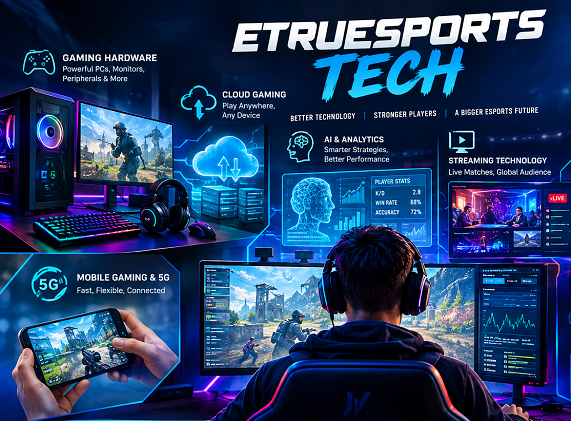
EtrueSports tech is therefore more than simply gaming equipment. It represents an ecosystem where hardware, software, internet infrastructure, artificial intelligence, data analytics, streaming technology, and esports platforms work together.
Also Read: Gaming Updates From EtrueSports EtrueGames
What Is EtrueSports Tech?
EtrueSports tech can be understood as the technology and digital innovation associated with esports and modern gaming. It covers the tools that players use, the platforms that host games and competitions, and the technologies that allow audiences to watch, interact with, and follow competitive gaming.
The concept includes gaming PCs, consoles, smartphones, peripherals, gaming networks, cloud services, streaming platforms, tournament software, game analytics, anti-cheat systems, and emerging technologies.
For competitive players, technology can directly affect performance. A high-refresh-rate monitor can provide smoother visuals, while a responsive gaming mouse can improve precision. Similarly, a stable internet connection can reduce latency and help players respond quickly during online matches.
For audiences, technology provides high-quality streams, live statistics, interactive features, and social communities. As these technologies continue improving, esports is becoming increasingly accessible to players and viewers around the world.
The Role of Gaming Hardware
Gaming hardware is one of the most visible parts of etruesports tech. Professional and competitive players often require hardware that can deliver reliable performance under demanding conditions.
A powerful gaming PC may include a high-performance processor, dedicated graphics card, sufficient RAM, and fast storage. These components help games run at higher frame rates and allow players to maintain smooth performance during competitive matches.
Gaming monitors are equally important. Competitive players often prefer displays with high refresh rates and low response times because smooth motion can improve the gaming experience. Resolution is also important, although competitive players may prioritise frame rate and responsiveness depending on the game.
Gaming peripherals are another major part of the ecosystem. Mechanical keyboards, precision mice, headsets, controllers, microphones, and mousepads can all contribute to a player’s setup.
Internet Speed and Low Latency
Online esports depends heavily on internet infrastructure. Even an excellent gaming computer cannot completely compensate for an unstable network.
Latency, commonly referred to as ping, measures the time it takes for data to travel between a player’s device and the game server. Lower latency generally means a faster response between player actions and what happens on the server.
For competitive gaming, network stability can be just as important as raw download speed. Packet loss, connection interruptions, and sudden latency spikes can negatively affect gameplay.
Modern esports technology therefore includes optimised servers, improved routing, high-speed broadband, fibre connections, and network-monitoring systems. These technologies help create more consistent online matches.
Artificial Intelligence in Gaming
Artificial intelligence is becoming an increasingly important part of gaming technology. AI can be used in game development, player analytics, matchmaking, moderation, customer support, and security.
Game developers can use AI technologies to create more responsive non-player characters and dynamic environments. AI can also help analyse large amounts of gameplay data.
In esports, analytics systems can examine player statistics such as accuracy, movement, reaction patterns, objective participation, and team performance. Coaches and players can use these insights to identify weaknesses and develop better strategies.
AI may also play a role in detecting suspicious behaviour. Advanced systems can analyse gameplay patterns and identify activity that may require further investigation.
Cloud Gaming and Esports
Cloud technology is another important development in the gaming industry. Traditional gaming requires users to own hardware capable of running demanding games. Cloud gaming moves some of the processing workload to remote servers.
The user receives a video stream of the game while sending controls back to the server. This approach can potentially allow players to access demanding games on less powerful devices.
Cloud technology can also benefit esports infrastructure. Tournament organisers may use cloud services for data storage, broadcasting, analytics, event management, and scalable server resources.
However, cloud gaming still depends heavily on network quality. Latency and bandwidth remain important considerations, especially for competitive games where fast reactions matter.
Streaming Technology and Esports
Streaming has transformed esports from a niche activity into a form of digital entertainment that can reach global audiences.
Players, teams, tournament organisers, and content creators can broadcast gameplay through online platforms. Modern streaming technology supports high-definition video, live chat, overlays, statistics, alerts, and multiple camera feeds.
Professional esports broadcasts can resemble traditional sports productions. Viewers may see player statistics, team information, instant replays, expert commentary, interviews, and real-time match information.
This creates opportunities for players and creators to build communities around their gaming content.
Data Analytics in Competitive Gaming
Data has become extremely valuable in esports. Professional teams can collect enormous amounts of information from matches and practice sessions.
Analytics can help answer questions such as:
- Which strategies produce the best results?
- How often does a team win specific objectives?
- Which areas of a map are most successful?
- How does a player perform under pressure?
- What mistakes occur most frequently?
- Which opponents create the biggest challenges?
Instead of relying entirely on intuition, coaches can combine experience with objective data.
This is one of the most important aspects of etruesports tech because competitive gaming increasingly resembles other professional sports, where performance analytics influence training and strategy.
Anti-Cheat Technology
Fair competition is essential to esports. As competitive gaming has become more valuable, cheating has also become a significant technological challenge.
Anti-cheat systems attempt to detect unauthorised software, unusual behaviour, modifications, and other forms of unfair play. Developers can use client-side and server-side approaches to protect competitive environments.
No anti-cheat system is perfect, but continued technological development can make competitive gaming more secure.
Anti-cheat technology is particularly important for tournaments where rankings, prize pools, sponsorships, and professional careers may depend on match results.
Mobile Esports Technology
Esports is no longer limited to desktop computers and consoles. Mobile gaming has become an important part of competitive gaming.
Modern smartphones can offer powerful processors, high-refresh-rate displays, advanced graphics capabilities, and fast wireless connectivity. This allows competitive games to run on portable devices.
Mobile esports also has the advantage of accessibility. Many people already own smartphones, making mobile gaming easier to access than purchasing a dedicated gaming computer.
As smartphone hardware and mobile networks improve, mobile competitive gaming is likely to remain an important part of the wider esports technology ecosystem.
Augmented Reality & Virtual Reality
Virtual reality and augmented reality are emerging technologies that may define the future of gaming.
Virtual reality immerses players in digital worlds using special headsets and motion-tracking technology.
Augmented reality combines digital elements with the physical world.
Although traditional esports currently relies heavily on conventional screens and controllers, immersive technologies could introduce new competitive formats.
Future esports competitions may potentially involve motion tracking, immersive arenas, spatial audio, and interactive environments. The development of lighter headsets and improved tracking systems could make these experiences more practical.
Gaming Peripherals and Player Performance
Small improvements in equipment can matter significantly to competitive players.
A gaming mouse with adjustable sensitivity allows players to customise their aiming preferences. Mechanical keyboards can provide fast and consistent key responses. High-quality gaming headsets can help players identify directional audio cues.
However, expensive equipment does not automatically create a professional player. Skill, practice, strategy, teamwork, communication, and experience remain essential.
The best technology should support a player’s abilities rather than replace them.
EtrueSports Tech and Esports Broadcasting
Technology has transformed how esports tournaments are produced and distributed.
Modern tournament broadcasts can include:
| Technology | Role in Esports |
|---|---|
| Live streaming | Delivers matches to global audiences |
| Game servers | Host competitive matches. |
| Analytics | Provides player and team statistics |
| AI systems | Supports analysis and moderation |
| Anti-cheat tools | Protect competitive integrity. |
| High-refresh monitors | Improve competitive gameplay |
| Gaming peripherals | Support precision and responsiveness. |
| Cloud services | Provide scalable infrastructure. |
| Broadcasting software | Produces professional live events |
| Social platforms | Build communities around competitions. |
These technologies work together to create a complete esports viewing experience.
The Future of EtrueSports Tech
The future of etruesports tech is likely to involve even greater integration between gaming and emerging technologies.
Artificial intelligence may become more useful for coaching and personalised training. Advanced analytics could provide players with detailed performance reports after every match.
Cloud infrastructure may continue improving accessibility and scalability. Faster internet networks could reduce latency and make competitive online gaming more reliable.
Immersive technologies such as VR and AR could create new categories of esports. Meanwhile, smartphones will likely continue becoming more powerful and capable of supporting sophisticated competitive games.
Another important trend is accessibility. Developers and hardware manufacturers are increasingly interested in making gaming technology available to wider audiences. This could help esports expand into new regions and communities.
How Players Can Benefit From Gaming Technology
Players do not necessarily need the most expensive setup to benefit from gaming technology. Instead, they should focus on equipment and services that solve their specific problems.
A stable internet connection should generally be a priority for online competitive games. Players should also ensure their computer or mobile device can maintain stable performance.
Next, players can consider peripherals that match their gaming style. For example, a competitive FPS player may prioritise a responsive mouse and high-refresh-rate display, while a strategy gamer may prioritise screen resolution and comfortable input devices.
Software is also important. Recording gameplay, analysing statistics, adjusting settings, and monitoring performance can help players identify areas for improvement.
EtrueSports Tech for Content Creators
Technology is equally important for gaming content creators. A creator may need a capable computer, microphone, webcam, lighting, recording software, editing tools, and a reliable internet connection.
Streaming technology allows creators to communicate directly with audiences. Social media platforms can then help distribute clips, highlights, guides, reviews, and other content.
This has created a new career ecosystem around gaming. Players are no longer limited to competing professionally. They can also become streamers, commentators, coaches, analysts, editors, journalists, or gaming influencers.
Challenges Facing Esports Technology
Despite rapid development, esports technology faces several challenges.
Cost is one major issue. High-performance gaming hardware can be expensive, which may create barriers for players who want to compete at a high level.
Internet access is another challenge. Players in regions with limited broadband infrastructure may experience higher latency or unstable connections.
Cybersecurity and privacy are also increasingly important. Gaming platforms collect significant amounts of user data, meaning developers need strong security practices.
Finally, technology changes rapidly. Hardware and software can become outdated quickly, requiring players and organisations to continually adapt.
Why EtrueSports Tech Matters
EtrueSports tech matters because technology is now fundamental to nearly every aspect of competitive gaming.
Players use technology to practise and compete. Coaches use analytics to develop strategies. Tournament organisers use servers and broadcasting systems to run events. Viewers use streaming platforms to watch competitions. Developers use advanced software to create increasingly sophisticated games.
The result is a connected ecosystem in which technology supports both participation and entertainment.
As esports continues to grow, technological innovation will remain one of its most important driving forces.
(FAQs): About etruesports tech
What is etruesports tech?
EtrueSports tech refers broadly to technologies associated with gaming and esports, including gaming hardware, software, networking, streaming, analytics, artificial intelligence, cloud services, and competitive gaming infrastructure.
Why is technology important in esports?
Technology provides the hardware, internet infrastructure, software, servers, analytics, broadcasting systems, and security tools needed to operate modern esports competitions.
What gaming hardware is important for esports?
Important hardware can include a capable gaming PC or console, high-refresh-rate monitor, responsive mouse and keyboard or controller, gaming headset, and reliable networking equipment.
Does internet speed affect competitive gaming?
Yes. Connection stability and latency can significantly affect online gameplay. A stable, low-latency connection is particularly valuable in fast-paced competitive games.
How is AI used in esports?
AI can assist with gameplay analytics, player performance analysis, moderation, matchmaking, game development, and security or anti-cheat systems.
Is mobile gaming part of esports technology?
Yes. Smartphones now support many competitive games, and mobile esports has become an important part of the wider gaming industry.
What is the future of etruesports tech?
Future developments may include improved AI analytics, cloud gaming, faster networks, advanced broadcasting, immersive VR/AR experiences, and increasingly powerful gaming devices.
Do expensive gaming devices guarantee better performance?
No. Better hardware can provide technical advantages such as smoother gameplay and improved responsiveness, but skill, practice, strategy, teamwork, and experience remain essential.
How can beginners use esports technology?
Beginners can start with a reliable device, stable internet connection, comfortable peripherals, and appropriate game settings. They can gradually upgrade equipment as their skills and needs develop.
Why is anti-cheat technology important?
Anti-cheat technology helps protect fair competition by identifying or preventing unauthorised tools and suspicious behaviour in competitive gaming environments.
Conclusion: etruesports tech
EtrueSports tech represents the intersection of gaming, esports, hardware, software, internet infrastructure, data, artificial intelligence, streaming, and emerging technologies. From powerful gaming computers and responsive peripherals to cloud computing and advanced analytics, technology has become central to competitive gaming.
The future is likely to bring even more innovation. AI-powered analysis, faster networks, cloud services, immersive technologies, and increasingly powerful mobile devices could transform how players compete and audiences experience esports.
Gamers’ tech know-how can help them build better setups and make smarter choices. It can help improve content creators’ production quality and audience engagement. Technology can provide infrastructure for esports organisations to run professional competitions.
Ultimately, the continued evolution of etruesports tech will help shape the next generation of gaming and competitive entertainment.