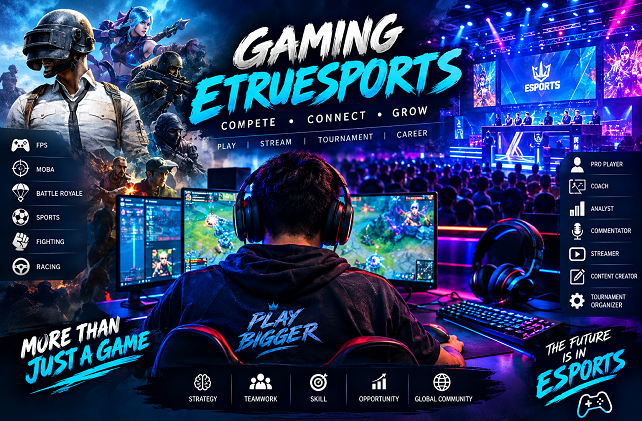

The world of competitive gaming has changed dramatically over the past decade. What was once considered a hobby has developed into a global entertainment industry with professional players, international tournaments, dedicated teams, streaming platforms, sponsors, and millions of fans. At the centre of this transformation is the growing concept of gaming etruesports.
Gaming esports can be understood as the broader ecosystem surrounding competitive video gaming. It includes players competing against each other, esports organisations, tournaments, gaming communities, live broadcasts, content creators, coaches, analysts, sponsors, and the technology that supports competitive play.
Unlike casual gaming, competitive esports focuses heavily on skill, strategy, teamwork, communication, consistency, and performance. Popular competitive titles can attract audiences from different countries, while major tournaments can offer significant prize pools and opportunities for professional gamers.
As internet connectivity, gaming hardware, mobile devices, and streaming services continue to improve, gaming esports is becoming increasingly accessible. Players no longer need to live in major cities or own expensive gaming setups to begin participating in competitive gaming. Many competitive games are available on smartphones and affordable computers, opening the door for new players around the world.
Also Reed: Harmonicode Gaming Guide 2026
What Is Gaming Etruesports?
Gaming etruesports refers to the competitive side of gaming, where individuals or teams participate in organised matches and tournaments. The term combines the idea of gaming with the competitive esports environment.
In a typical esports competition, players follow specific rules and compete to achieve a defined objective. Depending on the game, the objective may involve defeating another team, scoring more points, completing an objective, surviving longer, or achieving victory through strategic gameplay.
Esports competitions can take place online or in physical venues. Online tournaments allow players from different regions to compete remotely, while major events may bring professional teams and fans together in large arenas.
The gaming and esports ecosystem also extends beyond players. Coaches develop strategies, analysts study opponents, commentators explain matches, organisers manage tournaments, and content creators build communities around games and players.
This makes esports much more than simply playing video games. It is a complete competitive and entertainment ecosystem.
How Gaming Etruesports Work
The gaming and esports industry operates through several interconnected components. Players are the foundation, but successful competitive gaming requires many other people and organisations.
A professional player usually joins a team or organisation. The team may provide coaching, training schedules, equipment, management, and competition opportunities. Players practise regularly to improve their individual mechanics and team coordination.
Before a tournament, teams often study their opponents. They analyse previous matches, identify weaknesses, develop strategies, and practise specific situations. During the competition, communication and decision-making become extremely important.
Tournament organisers establish rules, schedules, competition formats, and prize structures. Matches may be played in a group stage, knockout format, league system, or combination of different formats.
Streaming is another major part of gaming esports. Fans can watch matches live through online platforms, while commentators and analysts provide explanations and entertainment.
Popular Types of Gaming Etruesports
Gaming esports covers many different genres. Each genre requires a different combination of skills.
1. Multiplayer Online Battle Arena
MOBA games involve teams competing against each other on a strategic battlefield. Players usually control individual characters with different abilities and roles.
Team coordination is extremely important in these games. Players need to understand positioning, objectives, resource management, and timing.
2. First-Person Shooter Games
FPS esports focuses on shooting accuracy, movement, communication, reaction time, and tactical decision-making.
Professional FPS players often spend significant amounts of time practising aim, map knowledge, team strategies, and competitive scenarios.
3. Battle Royale
Battle royale games place numerous players or teams into a large environment where they compete to become the final survivor or winning team.
These games combine mechanical skill with strategy. Players must decide where to land, how to collect resources, when to fight, and when to avoid unnecessary battles.
4. Sports and Racing Games
Sports and racing games have also developed competitive communities. Players can compete in football, basketball, racing, and other virtual sports.
These games often attract fans who already enjoy traditional sports.
5. Fighting Games
Fighting games focus on one-on-one or team-based combat. Players need excellent timing, reaction speed, character knowledge, and an understanding of their opponent’s behaviour.
Important Elements of Gaming Etruesports
Several factors determine success in gaming esports.
| Element | Importance |
|---|---|
| Skill | Helps players perform effectively |
| Strategy | Allows teams to make better decisions |
| Communication | Essential for coordinated teamwork |
| Practice | Builds consistency and mechanical ability |
| Teamwork | Improves overall team performance |
| Mental focus | Helps players remain calm under pressure |
| Technology | Provides reliable competitive performance |
| Coaching | Helps identify weaknesses and improve tactics |
| Analysis | Provides information about opponents |
| Discipline | Maintains long-term competitive development |
Why Is Gaming Etruesports So Popular?
One major reason for the growth of gaming esports is accessibility. People can watch, play, and discuss competitive gaming from almost anywhere with an internet connection.
Traditional sports often require physical venues and equipment, whereas many esports competitions can be organised digitally. This allows tournaments to reach international audiences relatively easily.
Another factor is the growth of live streaming. Fans can watch professional players compete while communicating with other viewers through chats and online communities.
Social media has also helped esports players develop personal brands. A successful player can become both a competitive athlete and a content creator.
Mobile gaming has expanded the esports audience even further. Smartphones allow users to participate in competitive games without requiring a high-end desktop computer.
Gaming Etruesports and Professional Players
Professional players are one of the most visible parts of gaming esports. Becoming a professional gamer, however, requires much more than simply playing for several hours every day.
Professional players typically need strong game knowledge, mechanical skills, communication, discipline, and the ability to perform under pressure.
Training can involve reviewing previous matches, practising specific mechanics, participating in team sessions, studying opponents, and maintaining a consistent routine.
Mental preparation is also important. Competitive matches can involve significant pressure, particularly during important tournaments.
Successful players often treat gaming like a serious competitive discipline rather than casual entertainment.
How to Start a Gaming Etruesports Career
For someone interested in entering gaming esports, the first step is choosing a game that matches their interests and strengths.
After choosing a game, players should learn its mechanics and competitive fundamentals. Playing ranked matches can provide useful experience because ranked environments usually offer stronger competition than casual matches.
The next step is consistent practice. Instead of simply playing for long hours, players should identify weaknesses and practise specific areas.
Joining a gaming community can also help. Communities provide opportunities to find teammates, participate in smaller tournaments, and learn from experienced players.
Players who become consistently successful may eventually receive opportunities to join amateur or semi-professional teams.
A simple progression can look like this:
Choose a game → Learn fundamentals → Practice regularly → Play ranked matches → Join a team → Enter tournaments → Build a reputation → Pursue professional opportunities
Benefits of Gaming Etruesports
Gaming esports can provide several positive opportunities when approached responsibly.
Improved Strategic Thinking
Competitive games often require players to make decisions quickly. Players must evaluate risks, resources, opponents, and objectives.
Teamwork and Communication
Team-based games encourage players to communicate clearly and cooperate with teammates.
Career Opportunities
The esports ecosystem includes more careers than professional players. Potential roles include:
- Professional gamer
- Esports coach
- Analyst
- Tournament organiser
- Commentator
- Streamer
- Gaming content creator
- Team manager
- Graphic designer
- Video editor
- Social media manager
International Community
Gaming esports connects players from different countries and cultures through shared competitive interests.
Challenges in Gaming Etruesports
Despite its growth, esports also has challenges.
Competition can be extremely intense. Only a relatively small percentage of players reach the highest professional levels. Players therefore need realistic expectations.
Excessive gaming can also affect sleep, education, work, physical activity, and social life. A healthy schedule is important.
Another challenge is maintaining performance over time. Games constantly change through updates, new characters, maps, balance adjustments, and evolving strategies.
Professional players must continually adapt to remain competitive.
Gaming Etruesports and Technology
Technology is one of the most important foundations of modern esports.
High-performance computers, gaming monitors, keyboards, mice, controllers, headsets, smartphones, and stable internet connections can all influence competitive experiences.
However, technology alone does not create a professional player. Skills, strategy, teamwork, and decision-making remain essential.
Artificial intelligence and advanced analytics may also influence esports in the future. Data analysis can help teams understand player performance, opponent strategies, and tactical patterns.
Virtual reality and other emerging technologies could eventually introduce new forms of competitive gaming.
The Business Side of Gaming Etruesports
Gaming esports has developed into a business ecosystem involving teams, publishers, tournament organisers, sponsors, broadcasters, advertisers, and content creators.
Revenue can come from sponsorships, advertising, media rights, merchandise, ticket sales, game-related purchases, and content platforms.
Brands may partner with esports teams or tournaments to reach younger and digitally engaged audiences.
Esports organisations can also build communities around their teams by producing videos, livestreams, social media content, and merchandise.
This commercial ecosystem helps support competitive tournaments and professional careers.
Gaming Etruesports in the Future
The future of gaming esports is likely to be shaped by technological innovation, mobile gaming, streaming, and global connectivity.
Mobile esports could continue expanding because smartphones are more accessible than high-end gaming computers in many markets.
Cloud gaming could also influence how people access competitive games, although competitive players will continue to care deeply about latency and performance.
Better streaming technology may make tournaments more interactive and immersive.
Meanwhile, esports education and training programmes may become more common as organisations recognise that competitive gaming requires structured skills and professional management.
The industry may also continue becoming more diverse, providing opportunities for players, creators, organisers, and professionals from different backgrounds.
Gaming Etruesports vs Traditional Gaming
| Feature | Casual Gaming | Gaming Etruesports |
|---|---|---|
| Main Goal | Entertainment | Competitive performance |
| Competition | Usually optional | Central component |
| Training | Flexible | Structured |
| Teamwork | Sometimes | Often essential |
| Tournaments | Limited | Common |
| Professional Careers | Less common | Multiple opportunities |
| Audience | Individual/friends | Local and global communities |
| Performance Analysis | Rare | Frequently used |
The biggest difference is the competitive structure. Casual gaming is primarily focused on entertainment, while esports gaming emphasises measurable performance and organised competition.
Tips for Improving in Gaming Etruesports
If you want to improve your competitive performance, focus on quality rather than simply increasing the number of hours you play.
1. Master the fundamentals: Learn movement, controls, mechanics, maps, characters, weapons, or other core systems.
2. Review your mistakes: After a match, identify what went wrong instead of blaming teammates.
3. Practice specific skills: Focused practice is generally more useful than playing without a goal.
4. Improve communication: In team games, concise and useful communication can make a major difference.
5. Watch high-level gameplay: Observing experienced players can help you understand positioning and decision-making.
6. Maintain a healthy routine: Sleep, exercise, breaks, and proper nutrition can support concentration and performance.
7. Stay updated: Competitive games often change through patches and updates, so players need to understand the current competitive environment.
(FAQs)
What is gaming etruesports?
Gaming esports refers to the competitive gaming ecosystem involving professional and amateur players, teams, tournaments, streaming, coaching, analysis, and esports communities.
Is gaming etruesports the same as esports?
The concepts are closely related. “Esports” is the widely established term for organised competitive video gaming, while “gaming esports” can be used as a broader keyword or phrase describing the competitive gaming ecosystem.
Can anyone participate in gaming etruesports?
Yes. Many competitive games offer ranked modes and community tournaments that allow beginners and experienced players to participate.
How can I become a professional esports player?
Start by selecting a competitive game, mastering its fundamentals, practising consistently, competing in ranked matches and tournaments, and building experience with a team.
Is gaming etruesports a real career?
Yes. Professional gaming is one career path, but the wider industry also offers opportunities in coaching, analysis, streaming, content creation, tournament management, marketing, production, and team management.
Do I need an expensive gaming PC?
Not always. The required hardware depends on the game. Some competitive mobile and PC games can be played effectively on relatively affordable devices.
Is esports good for young people?
Competitive gaming can develop skills such as teamwork, strategic thinking, and communication, but it should be balanced with education, physical activity, sleep, and other responsibilities.
What makes a successful esports player?
Strong mechanical skills, game knowledge, communication, strategic thinking, discipline, adaptability, and the ability to remain focused under pressure are all important.
Conclusion
Gaming etruesports represents the rapidly developing world of competitive gaming and the ecosystem surrounding it. From professional tournaments and esports organisations to streaming, content creation, coaching, and technology, competitive gaming has become much larger than simply playing video games.
For aspiring players, the journey starts with learning the fundamentals, practising consistently, competing against stronger opponents, and developing teamwork and communication skills. For fans, gaming etruesports offers exciting competitions and communities that connect people across geographical boundaries.
As gaming technology, mobile platforms, streaming services, and online communities continue to develop, the competitive gaming industry is likely to evolve further. Whether someone wants to become a professional player, streamer, coach, analyst, or simply a dedicated fan, gaming esports provides a wide range of possibilities in the modern digital entertainment landscape.


Pingback: ETSJavaApp Release Date 2026: Latest Updates & Timeline